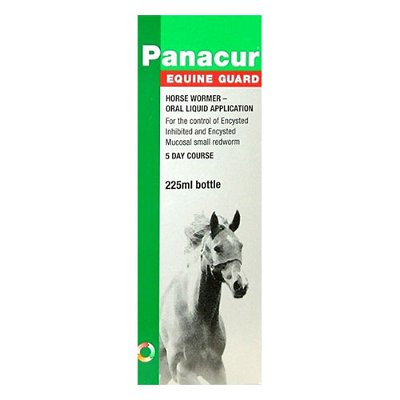


Panacur Equine Guard liquid horse wormer.
A benzimidazole wormer given preferably in November and/or January to eliminate encysted small redworms. Panacur Guard is given daily for five days.
This ‘five day course’ will of course also treat any other worms sensitive to Panacur including most worms other than tapeworm and Bots.
Dosing is 5ml per 65 kg bodyweight daily mixed with grain or concentrate daily for five days.
It is suitable for pregnant mares and young foals.
A course may be given at any time of the year to bought-in horses or others where the worming history is not known.
One bottle will treat a 600kg horse (225ml)
Presentation A 10% suspension of Fenbendazole as a ready to administer oral anthelmintic for horses. 1ml Panacur Equine Guard contains 100mg active ingredient Fenbendazole.
Uses For the treatment and control of adult and immature roundworms of the gastrointestinal tract in horses and other equines.
Panacur Equine Guard is effective for the treatment and control of encysted mucosal 3rd and 4th stage small strongyle larvae and is also effective against encysted inhibited 3rd stage small strongyle larvae in the mucosa.
Panacur Equine Guard is also effective in controlling other immature and mature roundworms including large redworm (Strongylus edentatus and Strongylus vulgaris) and migrating large redworm, Ascarids (Parascaris equorum), Oxyuris and Strongyloides species and benzimidazole susceptible adult and immature small strongyles.
Panacur Equine Guard also has an ovicidal effect on nematode eggs.
No dietary control is required before or after treatment.
For the treatment and control of migrating and tissue larval stages of large strongyles, encysted mucosal 3rd and 4th stage small strongyle larvae and encysted inhibited 3rd stage small strongyle larvae in the mucosa administer 5ml Panacur Equine Guard per 65kg bodyweight daily for 5 days (= 7.5mg fenbendazole/kg bodyweight daily for 5 days).
Panacur Equine Guard can be easily administered by mixing with grain or concentrate feed.
The full daily dosage must be given as one administration. Pregnant mares and foals may also be safely treated with fenbendazole at therapeutic dosage levels.
Assess bodyweight as accurately as possible before calculating the dosage. The use of a ‘weigh band’ is recommended.
Recommended dosing programme Treatment of encysted inhibited and encysted mucosal dwelling larvae should be performed in the autumn (ideally late October/November) and again in the Spring (ideally in February). However, for horses that fail to maintain condition or bought-in horses with unknown worming history, the treatment can be given at any time of the year.
Treatment with Panacur Equine Guard should be given in addition to routine worming during the grazing season.
Our company is built on the foundation of excellent customer service. We are continually striving to enhance our customer's online shopping experience and meet their expectations. We appreciate any suggestions that you may have which may help us to better serve you. You can contact us at customerservice@BudgetPetCare.com with your feedback and suggestions and do let us know if we can use your comments on our website. Here is a selection of some testimonials from our happy customers:
Packaging Quantities 225ml multidose containers.
Further information Panacur has been extensively used for the treatment of worm infestations in exotic animal species.
For further information on suggested dose rates, please contact the Veterinary Adviser of the Company. Fenbendazole belongs to the benzimidazole (1—BZ) class of anthelmintics.
Studies have indicated that inhibited 3rd stage small strongyle larvae represent 50% of the total larval population in the horse.
Congratulations to the winner of this month's Question of the Month, peggy j. who wins $100 for the following question:
Muffy was a rescue from a puppy mill at age 1. We’ve overcome many problems, but now we have 2 I’m not sure how to fix. she itches and chews all the time like she has fleas, but there are no fleas. I do shampoo her with flea shampoo that I got when she did have fleas a year ago, and I did try switching to a conditioning shampoo for a while with no help. I bathe her about every 2 weeks because after a week she starts to stink.. strong dog odor, and after a week her scratching and chewing get...?
View our vet's reply