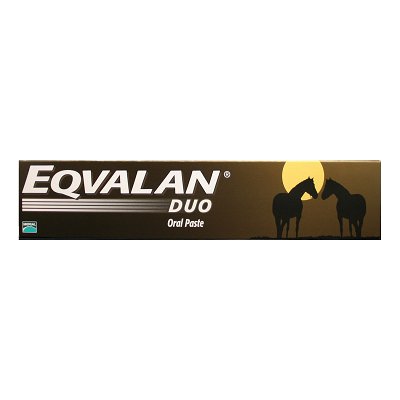


Eqvalan Duo Horse Wormer is used for the treatment of mixed cestode (tapeworm) and nematode (roundworm) or arthropod (bot) infestations in horses.
The contents of one syringe will treat horses up to 600kg.
The recommended dose is 200 mcg ivermectin per kg bodyweight and 1mg praziquantel per kg bodyweight (corresponding to 1.29g of paste per 100kg bodyweight in a single treatment).
Bodyweight and dosage should be accurately determined prior to treatment. The contents of one syringe will treat horses up to 600kg.
Calibrated markings are provided at 100kg bodyweight intervals.
The syringe should be adjusted to the calculated dosage by setting the ring on the appropriate place on the plunger. Parasite control program Veterinary advice should be sought on appropriate dosing programs and stock management to achieve adequate parasite control for both tapeworm and roundworm infestations.
Dosing instructions EQVALAN DUO oral paste is for oral administration only. While holding the plunger, turn the knurled ring on the plunger ¼ turn to the left and slide it so the stop ring is at the prescribed weight marking.
Lock the ring in place by turning it ¼ turn to the right in order to bring the two arrows, the one visible on the ring and the one on the plunger rod, into alignment. Make sure the horse's mouth contains no feed.
Remove the cover from the tip of the syringe. Insert the syringe tip into the horse’s mouth at the interdental space and deposit the paste on the base of the tongue. Immediately raise the horse’s head for a few seconds after dosing and ensure that the paste is consumed.
Our company is built on the foundation of excellent customer service. We are continually striving to enhance our customer's online shopping experience and meet their expectations. We appreciate any suggestions that you may have which may help us to better serve you. You can contact us at customerservice@BudgetPetCare.com with your feedback and suggestions and do let us know if we can use your comments on our website. Here is a selection of some testimonials from our happy customers:
Safety studies were not conducted in foals younger than 2 months of age, nor in stallions, therefore EQVALAN DUO cannot be recommended for use in these categories of animals.
The use of EQVALAN DUO may be dangerous to aquatic life. Horses should not have direct access to surface waters and ditches during treatment.
EQVALAN DUO has been formulated for use in horses only. Cats, dogs, especially Collies, Old English Sheepdogs and related breeds or crosses, and also turtles and tortoises may be adversely affected by the concentration of ivermectin in this product if they are allowed to ingest spilled paste or have access to used syringes.
Parasite resistance to any particular class of anthelmintic may develop following frequent, repeated use of an anthelmintic of that class. Some horses with heavy infections of Onchocerca spp. microfilariae have experienced oedema and pruritus following treatment, assumed to be the result of the death of large numbers of microfilariae. These signs resolve within a few days but symptomatic treatment may be advisable.
In cases of heavy infestations with tapeworms, signs of mild, transient colic and diarrhoea may be observed.
There have been rare reports of swelling and irritation of the mouth, lip and tongue, and of salivation following administration of EQVALAN DUO.
These reactions have been transitory in nature, appearing within 1 hour and abating within 24-48 hours following administration.
No undesirable effects related to treatment were observed in 2 month old horses treated with EQVALAN DUO at up to three times the recommended dose and in adult horses treated at ten times the recommended dose.
Transient decreased food consumption, increased body temperature and impairment of vision were noticed in horses treated twice with an ivermectin oral paste at ten times the recommended dose (i.e. 2 mg/kg b.w.).
All changes disappeared within five days. No antidote has been identified; however, symptomatic therapy may be beneficial. User warnings Wash hands after use.
Do not smoke, eat or drink while handling the product. For animal treatment only.
This product may cause skin and eye irritation. Therefore, the user should avoid contact of the product with the skin and eyes. In case of contact, rinse immediately with plenty of water. In the case of accidental ingestion or eye irritation after contact seek medical advice immediately and show the package leaflet or the label to the physician.
Use during pregnancy and lactation Ivermectin-praziquantel combination can be used after the first three months of gestation and during lactation. In the absence of clinical data in early pregnancy EQVALAN DUO can only be used in the first three months of gestation according to a risk benefit analysis by the veterinarian. Withdrawal periods Meat: 30 days.
Do not use in mares producing milk for human consumption. Container disposal EXTREMELY DANGEROUS FOR FISH AND AQUATIC LIFE.
Do not contaminate surface waters or ditches with product or used syringes. Dispose of any unused product and empty syringes in accordance with guidance from your local waste regulation authority.
Pharmaceutical precautions Keep out of the reach and sight of children. Store in the original container. Replace the cap after use. Part used syringes can be kept for up to 2 years after first use but should be used by the expiry date printed on the packaging.
Oral paste containing 1.55% w/w ivermectin and 7.75% w/w praziquantel
Congratulations to the winner of this month's Question of the Month, peggy j. who wins $100 for the following question:
Muffy was a rescue from a puppy mill at age 1. We’ve overcome many problems, but now we have 2 I’m not sure how to fix. she itches and chews all the time like she has fleas, but there are no fleas. I do shampoo her with flea shampoo that I got when she did have fleas a year ago, and I did try switching to a conditioning shampoo for a while with no help. I bathe her about every 2 weeks because after a week she starts to stink.. strong dog odor, and after a week her scratching and chewing get...?
View our vet's reply